
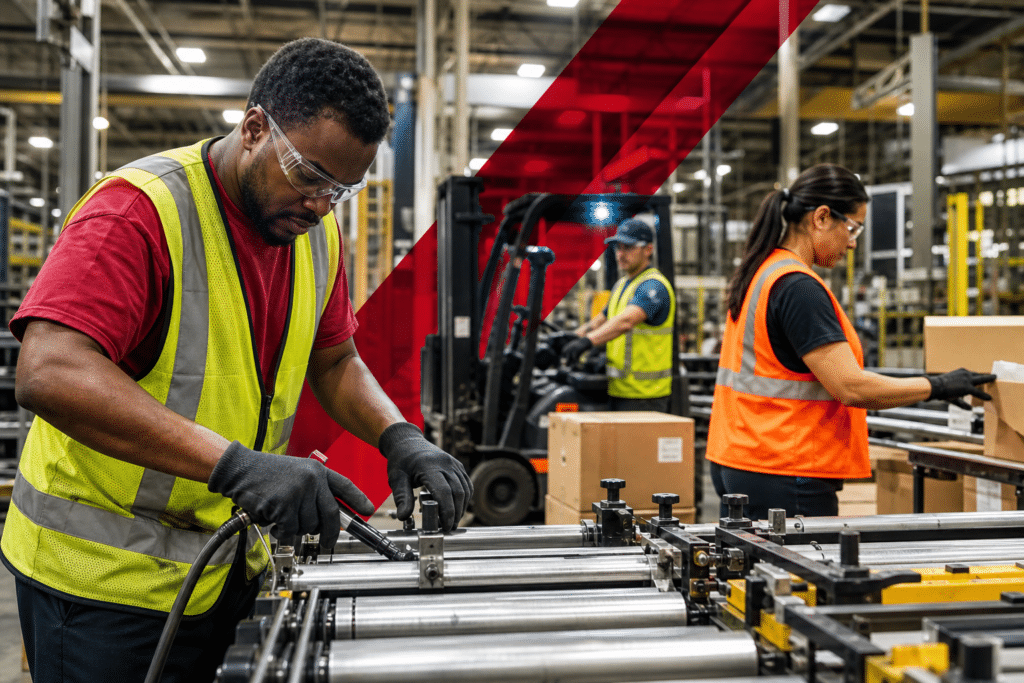
Picture a plant manager in Minneapolis who gets a call on a Tuesday: a key customer just doubled its order for Q1 delivery. The line is already running at capacity, two assembly roles are unfilled, and the last job posting sat online for three weeks before producing a single qualified applicant. If you run a production floor, manage staffing for a distribution center, or oversee HR for a light industrial operation, this scenario probably sounds familiar. It is the gap between how fast demand moves and how slowly traditional hiring responds.
Production schedules can shift in a matter of weeks. Hiring cycles, particularly for direct-hire roles, often take months once you factor in job postings, screening, interviews, background checks, and onboarding. That mismatch is no longer a minor inconvenience. Workforce agility is becoming as central to manufacturing performance as machine uptime or inventory accuracy. A press that cannot run because there is no operator to staff it costs you output just as surely as a mechanical breakdown does.
This article looks at what is actually driving the volatility manufacturers are seeing in labor demand, what a rigid staffing model quietly costs you when demand shifts, and how a more flexible workforce strategy closes that gap without asking you to carry permanent headcount you do not need year-round.
What Is Driving Unpredictable Manufacturing Workforce Needs
Demand volatility in manufacturing rarely comes from one source. It usually stacks up from several directions at once, and each one changes the shape of your staffing needs differently.
Seasonal and Cyclical Swings
Consumer buying patterns, contract manufacturing schedules, and retail calendars all create predictable but sharp peaks. A contract manufacturer supplying holiday goods may need double its production line staff for ten weeks and a fraction of that the rest of the year. Practitioners in this space often see the same pattern repeat annually, yet many operations still staff reactively instead of planning ahead of the curve.
Supply Chain Volatility
Ongoing disruptions in raw material availability and shipping timelines force plants to ramp production up or down with very little lead time. A single delayed shipment of components can suddenly turn a slow production week into an all-hands sprint once materials finally arrive.
The E-Commerce Effect
The growth of e-commerce and just-in-time fulfillment has pushed manufacturers toward shorter, more frequent production runs rather than long, stable batches. That means labor needs fluctuate week to week instead of settling into a predictable seasonal rhythm, which puts more pressure on staffing flexibility than any single peak season used to.
Reshoring and Nearshoring
Reshoring and nearshoring trends are bringing manufacturing volume back to domestic facilities faster than local labor markets can supply trained talent, a dynamic that industry labor reports have flagged as an emerging pressure point for plants across the Midwest and Sunbelt. Facilities in growing manufacturing hubs are discovering that the equipment and floor space came back before the workforce did.
The Hidden Cost of a Rigid Workforce Model
When staffing cannot flex with production, the costs show up in places that do not always land on a P&L line labeled “labor.” Overtime pay climbs as existing staff cover gaps. Quality slips as fatigued or under-trained workers rush to keep pace. Experienced employees burn out and leave, taking institutional knowledge with them. And a mis-hire made under pressure, someone rushed through the process just to fill a seat, can cost a business well beyond that worker’s salary once you account for training time, lost productivity, and the cycle of re-recruiting when the fit does not work out.
There is also an opportunity cost that is easy to underestimate: the orders you cannot accept because you are not confident you can staff them. A sales team that wins new business only to watch operations struggle to fulfill it is not really winning at all. For a closer look at how these pressures compound specifically in manufacturing environments, our breakdown of common manufacturing hiring challenges walks through the patterns operations managers run into most often.
None of this means rigid staffing was ever a bad decision on purpose. Fixed headcount made sense when demand was stable and predictable, and for some niche production environments with long, consistent runs, it still does. The trouble is that fewer manufacturers today operate in that kind of steady state.
Building a Staffing Model That Flexes With Demand
Workforce flexibility is not one strategy. It is a set of staffing models you can combine depending on how far out you can see demand and how long a given surge is likely to last.
-
Temporary staffing covers short, defined surges, such as a two-week rush order or an unexpected absence spike, without adding to permanent headcount.
-
Temp-to-hire staffing lets you evaluate a worker’s actual performance on your floor before extending a permanent offer, which lowers the risk of a costly mis-hire compared with direct-hire recruiting.
-
On-demand labor pools give you a standing bench of pre-screened workers you can call on with short notice, rather than starting the sourcing process from zero every time volume shifts.
Each model solves a different problem. Temporary staffing buys you speed. Temp-to-hire buys you confidence. On-demand pools buy you reduced lead time the next time demand spikes. Together, they let you match labor cost to actual production need instead of carrying a fixed roster sized for your busiest month, twelve months a year.
What an Agile Manufacturing Workforce Looks Like in Practice
An agile workforce is not simply one with access to temporary labor. It is one built with flexibility in mind from the ground up.
Cross-training is a foundational piece. Workers trained to move between assembly, packaging, and basic material handling let you reallocate labor internally when one station gets backed up, rather than waiting on new hires to cover a single function. Standardized onboarding also matters more than most operations realize: if a temporary worker can be safety-certified and productive on day one instead of day three, your effective ramp-up time shrinks considerably during a surge.
Scalable staffing partnerships round out the picture. Consider a mid-sized contract manufacturer, hypothetically operating across two states, that consolidates its contingent labor needs under a single staffing partner instead of managing separate agency contracts in each market. That single relationship gives them one point of contact, one set of fill standards, and one partner who already understands their production cadence, rather than five vendors relearning the account from scratch every peak season. This kind of consolidation is especially valuable for multi-location operations trying to reduce vendor overhead while keeping fill quality consistent. Our overview of seasonal warehouse staffing planning covers how to think through this kind of scaling before your next peak hits, not during it.
Where a Staffing Partner Fits Into Workforce Agility
None of this flexibility happens automatically. It requires a recruiting pipeline that already has workers screened and ready before you need them, not after. That is the core function a staffing partner plays. STS Staffing builds and maintains local recruiter relationships across Minnetonka, Shoreview, Las Vegas, Reno/Sparks, Phoenix, and Nashville, which means the workers placed on your floor are not applicants who happened to click “apply” that morning. Many are experienced temporary workers who return to STS between assignments because the relationship has already proven reliable, on both sides.
For operations without a dedicated HR function, this partnership extends beyond recruiting into the back-office work that eats into an operations manager’s day: worker classification, onboarding paperwork, and payroll administration. That structure also protects you from the compliance liability that comes with informal gig-platform arrangements, since the staffing partner serves as employer of record. If you want a fuller picture of the range of roles and sectors this kind of partnership covers, our page on staffing specialties outlines where these services apply most directly, and our manufacturing staffing solutions for employers page details how the model works specifically for production environments.
Getting Your Workforce Strategy Ready for the Next Demand Shift
The plant manager fielding that Tuesday phone call does not need a five-year workforce plan. They need a bench of reliable workers who can be on the floor within days, not weeks. If your current staffing model only works when demand is calm and predictable, it is worth auditing where the gaps would show up under pressure: which roles have no backup coverage, which peak periods catch you flat-footed every year, and whether your hiring process can actually move as fast as your production schedule requires. Start by mapping your last two demand surges against how long it took to staff them, and use that as your baseline for what needs to change.
If that audit reveals more risk than you would like, STS Staffing can help you build a workforce plan that flexes with production instead of lagging behind it, with placements moving fast enough to keep your line running when demand shifts again.